What Is a CDN & How Does It Improve Website Performance?
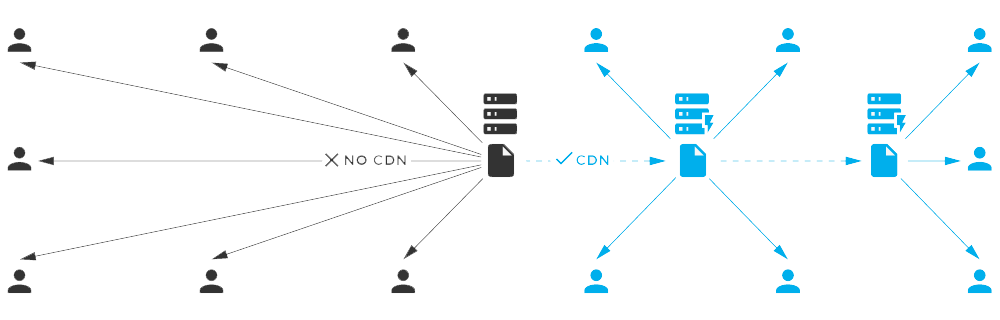
A Content Delivery Network (CDN) distributes content across geographically dispersed servers. User requests are routed to the nearest Point of Presence (PoP) instead of relying on a single source server, reducing latency and server load, while improving overall reliability and security.
How CDN Works?
A CDN implements a combination of DNS routing, intelligent traffic management, distributed caching, and edge computing to distribute content.
A) Request Routing and Edge Selection
When a user enters a website URL, the DNS system redirects the domain to the CDN instead of the origin server. Then, the CDN recognizes the user’s location and their network conditions. In the next step, the request is routed to the nearest or best-performing edge server (PoP). This process reduces round trip time (RTT), which is a primary factor in page load delay.
B) Content Caching and Delivery
The CDN stores cached data of the website on the edge servers. When there are requests from other users for the same data, the CDN loads it directly from the edge cache instead of contacting the origin server. This way, not only is the server’s load time greatly decreased, but also the bandwidth and load of the database are reduced.
If the content is not already cached (cache miss), the CDN should fetch it from the origin server, deliver it to the user, and then store a copy at the edge servers for future requests.
C) Dynamic Content Acceleration
Modern CDNs (2026 architecture) are not limited to static content. They also accelerate API requests, E-commerce checkout pages, personalized dashboards, and SaaS platforms.
This is achieved by TCP/QUIC optimization, HTTP/2 and HTTP/3 support, connection reuse, smart routing algorithms, and edge logic execution.
This allows dynamic content to load faster without incorrectly caching userspecific data.
Key Benefits of Using a CDN
1. Faster Website Loading Speed
By serving content from the closest CDN edge server, the physical distance between the server and the user is reduced. Lower latency results in faster initial connection, reduced page rendering time, improved user experience, and higher engagement rates.
The point is that the website’s speed improvements directly affect bounce rate and conversion performance.
2. Reduced Bandwidth Usage
Bandwidth consumption decreases when using a CDN, since the CDN absorbs most of the repeated requests. For high-traffic websites, this can significantly reduce operational costs. As the byproducts of this, we can point to decreased responses sent from the origin server and reduced hosting infrastructure costs.
3. Protection Against DDoS Attacks
A CDN acts as a protective shield between attackers and the origin server.
Instead of targeting your server directly, malicious traffic hits the CDN’s distributed network. Advanced CDN providers deliver automatic DDoS mitigation, rate limiting, bot detection, web application firewall (WAF), and IP reputation filtering.
This distributed architecture absorbs attack traffic before it reaches your infrastructure.
4. Improved Website SEO Performance
Google ranking algorithms heavily prioritize performance metrics such as page speed, core web vitals, server response time, and availability. A CDN improves these signals by reducing TTFB, stabilizing uptime, and enhancing global performance
Improved performance increases crawl efficiency and positively influences search visibility.
5. Increased Availability and Uptime
CDNs provide redundancy across multiple geographic regions. If one edge server fails, CDN automatically reroutes the traffic, minimizes service disruption, and prevents overload on the main server.
This ensures high availability even during traffic spikes.
6. Scalability During Peak Traffic
Traffic spikes which occure when launching a new product or having sales events can overwhelm origin servers. CDN handles short-term traffic surges without the need for further infrastructure upgrades by distributing the traffic to edge servers globally and instantly activating auto scaling mechanisms.
7. Free SSL and TLS Optimization
Most modern CDNs offer free SSL certificates plus autorenewals, TLS 1.3 and HTTP/3 support, and secure edge termination along with their CDN services.
These features enhance encryption performance while simplifying certificate management.
8. Advanced Firewall and Security Rules
CDNs allow custom rule configuration, including blocking specific geographic IPs, rate limits, IP whitelisting/blacklisting, application layer filtering, and API protection rules.
These features improve overall security posture.
Do CDNs Have Drawbacks?
Although CDNs provide significant advantages, they require correct configuration.
I. Cache Misconfiguration
Improper cache rules may lead to stale content, dynamic pages cached incorrectly, and login or session conflicts. Proper cache control headers and TTL configuration are essential.
II. Automatic Optimization Issues
Some CDNs automatically optimize images or compress files. If poorly configured, this may cause rendering delays while breaking scripts, affecting media quality.
It is generally recommended to optimize assets at the application level and use CDN optimization selectively.
III. Cost Structure Complexity
While CDNs reduce bandwidth costs, pricing models may include data transfer fees, request count, security feature tiers, and edge function execution costs.
Careful planning is required for large-scale projects.
Performance Testing With and Without CDN
You can measure CDN impact using performance tools such as Pingdom and GTmetrix. These tools demonstrate the difference in performance using the metrics below:
- Time to First Byte (TTFB)
- Overall load time
- Largest Contentful Paint (LCP)
- Global latency differences
- Total Blocking Time (TBT)
In most real-world scenarios, enabling a properly configured CDN significantly reduces global load time and improves Core Web Vitals metrics.
CDN Providers
Cloudflare, Fastly, Akamai, Amazon Cloudfront, MetaCDN, MaxCDN, and KeyCDN are some of the most popular CDN providers in the world.
Conclusion
A Content Delivery Network is no longer an optional enhancement; it is a fundamental component of modern web architecture. By distributing content across global edge servers, a CDN improves speed, enhances security, reduces bandwidth costs, increases scalability, and strengthens SEO performance.
In 2026, any performance-focused website architecture should consider CDN deployment as a core infrastructure layer rather than a secondary optimization tool.